LOD is free
There's no separate simplified mesh to generate, store, or stitch — the same hologram answers a near read and a far read, at whatever cost you choose to pay for that read.
Most voxel engines store a world as arrays of blocks and fake distant detail with mesh
simplification, mipmaps, or LOD popping. HoloVoxel stores a chunk of the world as one holographic
superposition instead: every voxel is bound (position ⊗ content) and summed into a
single vector, using the Phasor VSA codec. Reading a voxel back is a correlation
against that vector, and correlating with fewer components gives a cheaper, fuzzier answer — near stays
crisp, far goes soft, with no discrete LOD tiers and no popping between them.
dotnet add package EvaluatedApplications.HoloVoxelthe same read, at whatever cost you choose
There's no separate simplified mesh to generate, store, or stitch — the same hologram answers a near read and a far read, at whatever cost you choose to pay for that read.
A chunk only stores as many components as its LOD will ever need to read back, losslessly — the first k components of a truncated hologram are bit-identical to reading the same chunk in full.
Distant terrain looks soft because the engine genuinely has less information at that budget, not because a texture got downsampled — the same signal that saves compute also drives the look.
No rendering or graphics dependency, verified headless. You bring the renderer, block palette, and world source (or use the built-in procedural generator).
a reference shading pass, not a shipped renderer
HoloVoxel hands you decoded colour fields, triangulated meshes with analytic per-vertex normals, and a confidence signal for how unambiguous each decoded point is — drawing them is up to your own renderer. As a proof of concept, the same mesh/confidence output was shaded with ordinary Lambertian lighting, heightfield ambient occlusion, and confidence-driven haze at distance, against a naive flat-block bake of the identical chunk data.
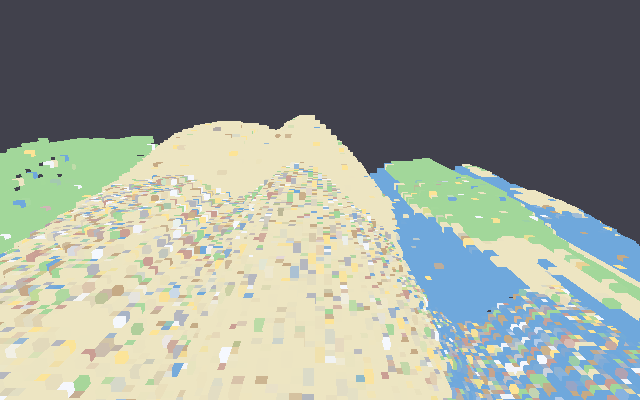
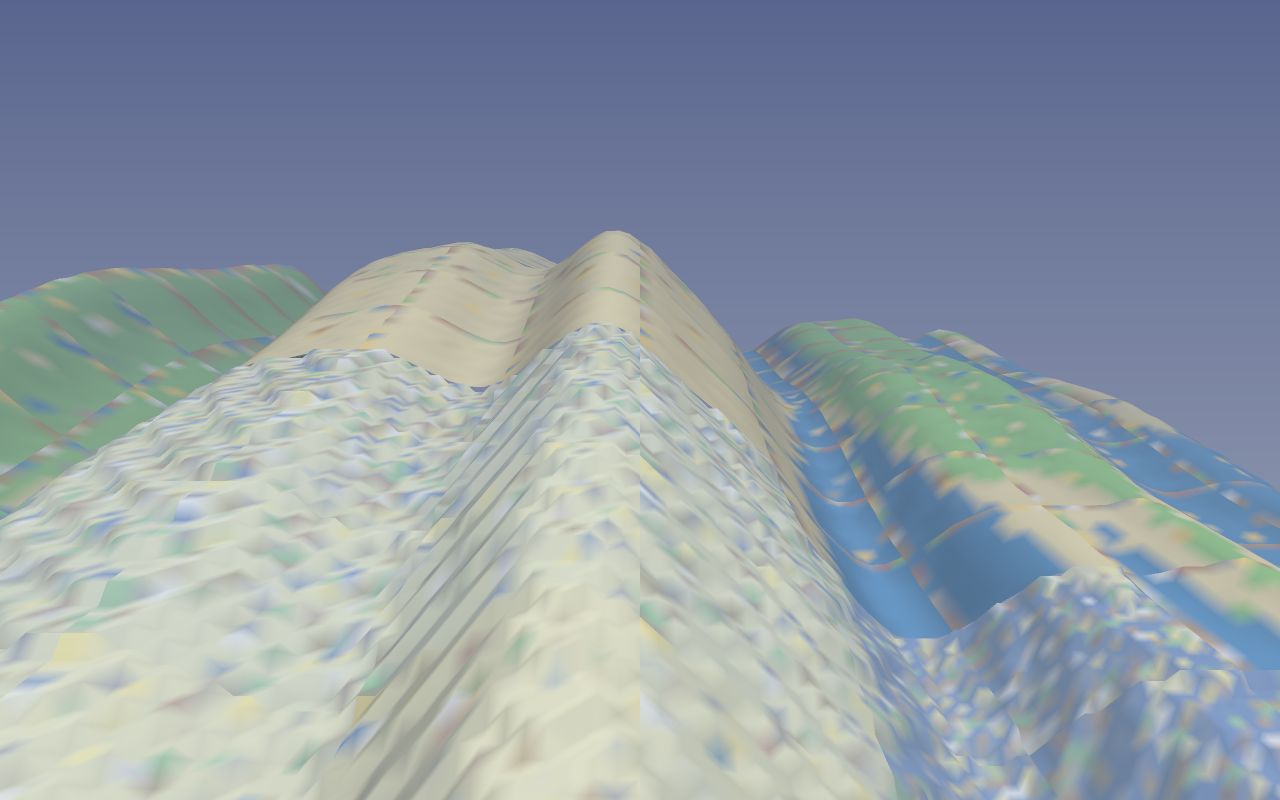
Same chunk, same engine data — DecodeMesh's analytic normals and FieldConfidence's ambiguity signal did the work; only the downstream shading changed. This shading recipe is a proof of concept, not something the package ships — HoloVoxel stays renderer-agnostic by design.
what you get
Encode a chunk once, decode it at any component budget as a colour field or a triangulated surface mesh with analytic per-vertex normals.
The same stored hologram serves a crisp near view and a soft far view; a distance-to-budget curve is provided as a starting point.
Exposes how unambiguous each decoded point is, turning that into a signal that spends more budget only where the world is genuinely ambiguous, instead of a flat distance curve everywhere.
Far reads average over a footprint of the underlying world data, for both terrain height and material, rather than sampling a single noisy point — smooth, coherent shapes instead of speckled noise, independent of the component-budget blur.
Storage cost tracks the LOD budget you actually plan to read at, not the size of the world.
HoloModel stores a creature or prop the same holographic way, with the same LOD and confidence machinery, independent of the terrain grid.
WorldGen with biomes, height fields, and optional maze layout — or supply your own world source and skip it entirely.
A pure flat-to-cylinder coordinate transform for cylindrical/ringworld spaces, on top of the same flat chunk storage.
this is the engine, not the renderer
HoloVoxel has no graphics or engine dependency and is verified headless — it hands you decoded colour fields, meshes, and confidence values; drawing them (shaders, GPU decode, a game engine binding) is up to the consuming front end. It's built on Phasor: HoloVoxel's chunk hologram is a direct application of the Phasor VSA codec, so if you're already using Phasor elsewhere, the same binding/correlation model is reused here for space instead of arbitrary data.
License: proprietary, DLL-only distribution — evaluation and non-commercial use are permitted, commercial use requires a commercial licence; no feature on this page is gated behind a tier or a licence key. Get it: dotnet add package EvaluatedApplications.HoloVoxel.